
This easy-to-use Religious Education Kickoff Retreat can be self-facilitated and is a great way for RE leaders to get aligned on your program’s core purposes and priorities. Dig into the latest thinking on what’s working – on Sunday mornings and throughout the week – in programs that are inviting, engaging and affirming for children, youth and families. Close with building a plan for your RE Team’s work in the year ahead.
Preparation
Planning the Basics
Who? When? For How Long?
The RE Kickoff Retreat is designed for your congregation’s RE leaders. This may include paid RE staff, your minister(s), your RE team, and key RE volunteers. At a minimum, these people should be included, and ideally the retreat should be scheduled for when they can all attend. You might also choose to invite some other folks, such as parent representatives. You don’t want to have so many people that it’s hard to have deep conversation, but it can be very helpful to have people with specific knowledge or a specific stake in your decisions in the room from the beginning.
The RE Kickoff Retreat is generally held in the late summer or early fall, which is an ideal time to think about the year to come, welcome and orient new leaders, and set intentions for the year.
This RE Kickoff Retreat agenda is designed to begin with 15-45 minutes of unstructured time for gathering followed by 2 hours of planned activities. (See two alternatives for structuring your time under the Schedule Overview section below; you can extend it to a half-day or break it into two shorter sessions.)
Preparing to Facilitate

The facilitator’s job is to make it easier for the group to have necessary conversations and make necessary decisions. They will need to manage the flow of conversation without dominating it with their own opinions and perspectives. Consider this ability as you select a facilitator.
Getting Ready
Decide upon a schedule for your time together, and whether and how you will provide food/refreshments and/or childcare.
As soon as you have made these decisions and chosen a date, time, and location, share all the information with your participants. Include the following links, and ask them to read the materials as pre-work before you gather:
- U.S. Surgeon General’s Advisory on Parenting and How We Can Respond
- The Continuum of De-Centering Curriculum
- Needs and Opportunities Identified by UU Youth
Whoever is facilitating should read through this entire article. Make sure you know how the retreat will flow, the intention of each activity, and how much time is allotted for each section.
Note: If you want more training on facilitation, especially in a multicultural context, we recommend the UU Institute course Facilitation for Transformation.
Logistical Considerations
Playing video: As part of this retreat, we invite you to watch a video together. Before the retreat, figure out how you will do that in your space. If it is not possible to watch the video together, distribute it to participants to watch before the retreat and remind them of the key points as part of that discussion.
Taking visible notes: Some of the following activities require taking visible notes. The classic way to do this is with giant paper posted on the wall, which someone writes on as the group generates ideas. You can also do this on a computer connected to a projector or a large screen.
Handouts:
- Review suggestions and prepare printed materials for the Orienting portion of the agenda
- Make copies of the materials, found below under Resources and included in the print-friendly 2025 RE Kickoff Retreat Guide and Agenda (PDF).
Schedule Overview
Schedule Option 1: Gathering Time + 2 Hours Planned Activities
Time | Activities | Goals |
|---|---|---|
15-45 minutes | Gathering | Greet one another |
20 minutes | Opening | Build a spiritual container |
20-25 minutes | Orienting | Review current plan |
25-30 minutes | Meeting the Moment | Build shared analysis of context |
40 minutes | Prioritizing and Planning | Align activities with priorities |
10 minutes | Closing | Integrate what you’ve learned |
Schedule Options 2 and 3
| Option 2: Half-Day Retreat | Option 3: Two 75 Minute Sessions |
|---|---|
| 3 hours and 15 minutes 15 minutes Gathering 20 minutes Opening 25 minutes Orienting 30 minutes Meeting the Moment 45 minutes Meal Break 45 minutes Prioritizing and Planning 15 minutes Closing | First Session: Second Session: |
Retreat Facilitation Guide
Gathering
Welcoming One Another and Getting Settled In to Your Space
15-45 minutes
Build some time into your schedule for gathering, greeting each other, and getting children settled into childcare. Offer beverages and snacks, or even a light meal. You may want to invite people to arrive anywhere from 15-45 minutes before your scheduled program starts.
Arrange your seating so everyone is comfortable. Set a chalice in the center of your circle. Test your technology. Play some music.
Before moving to the Opening, you may choose to lead an activity from Deeper Joy’s Bonding Harbor (such as Blobs and Lines) or Opening Up Beach (such as The Animal Game).
Opening
Grounding
5 minutes
Open with a Chalice Lighting, Opening Words, or an Opening Song.
Options for Opening (use one of these, or choose your own):
- Opening Reading: In Our Circle Again, by Shari Woodbury
- Opening Song: More of This, by The Sanctuary, Boston | YouTube (5:41)
- Opening Reflection: Prayer for the Lamp Keeper, by Joseph M. Cherry
Check-In
10 minutes
Go around the room and briefly share:
- Name and pronouns, if you wish
- Who’s in your family
- How are you feeling as we begin?
Ground Rules
3 minutes
Suggest to the group that the time you have together today is an opportunity to practice leadership skills essential for these times. As part of that practice, suggest the following group norms:
- Care for yourself (and your family) as needed; extend grace as others do the same
- Be as present as possible
- Take breaks when you need them
- Consent — share by choice; it’s okay to pass/pause
- Speak from your own experience
- Expect multiple perspectives
- Share space
- Pause for repair if needed
- Make room for joy, laughter, curiosity, sadness and silence
- Confidentiality — share your own experience only
Review the list and edit it as needed until your group agrees that it reflects and addresses your needs.
Notes to facilitator:
- If you find that your team consistently has trouble with these ground rules, it’s probably time to set aside time for a covenantal conversation
- If your team has an existing covenant, use that in place of these ground rules
RE Kickoff Goals and Schedule Overview
2 minutes
Tell the group: This RE Kickoff Retreat is designed to help us get aligned on our program’s core purposes and priorities. We will dig into the latest thinking on what’s working – on Sunday mornings and throughout the week – in programs that are inviting, engaging and affirming for children, youth and families. Then we’ll discuss and affirm our plan for our RE Team’s work in the year ahead.
Our agenda has us meeting for 2 hours and includes these parts:
- Opening, 20 minutes (which we’re just finishing up)
- Orienting, 20-25 minutes — during which we will go over our program’s mission/goals and map (or review) our current faith development plan for 2025-2026
- Meeting the Moment, 25-30 minutes — includes watching a video and then discussing the most urgent needs of parents, children, youth and families in our community
- Prioritizing and Planning, 40 minutes — during which we will make sure our energy and resources are being directed toward what’s most important and needed
- Closing, 10 minutes — where we will take a moment to integrate what we’ve discussed and appreciate the work we’ve done together
Orienting
20-25 minutes
If your Religious Education program has a written mission, statement of purpose, or list of goals, begin by sharing those. It may be helpful to post them in the room or provide a handout so the group can refer back to them later.
If you have a clear plan for your program for 2025-2026, have those who are most familiar with it share an overview with the group.
Provide enough details that everyone understands:
- What you will do (e.g. What classes will be offered for children and youth? What programs will be offered for families?)
- When programming will be offered (e.g. What will be offered on Sunday mornings, and how often? Will programs be offered at any other times?)
- Why you have chosen the model/curriculum/activities that are part of your plan (e.g. What are the goals of each curriculum? What are the needs you hope to address when you gather parents?)
- Who will lead various activities (e.g. Who is the staff and/or lay leader responsible for each activity? How many volunteers will be needed?)
It may be helpful to prepare a handout or look at the church website together, to ensure that everyone has access to the information they need to understand the program.
If you do not yet have a clear plan for 2025-2026, you may choose to:
- Review what was offered in 2024-2025, and/or
- Share a draft of the programming you may choose to offer in 2025-2026
Again, it may be helpful to prepare a handout so folks have something to consider and discuss later.
This is also a good time to talk with the group about the resources that are still needed to make your plans work (e.g. “If we want to offer middle school overnight retreats, we will need more adult volunteers”).
Note that it is likely that the group will want to jump into a deeper discussion – or even begin making changes to the plan – at this point. Let them know that there will be the opportunity to weigh in on priorities and plans later. Once you’ve oriented the group to the current status of your program plan, move on to the next section of the retreat agenda.
Meeting the Moment
Consider the Current Context
10 minutes
Provide participants with printed copies of the pre-work materials (linked below under Resources and included in the print-friendly 2025 RE Kickoff Retreat Guide and Agenda (PDF) found in Preparing to Facilitate, above).
Invite them to review the materials silently, without discussion, and to make some notes on these questions:
- Which of these trends seem to be true in our congregation?
- How have we responded to the challenges and opportunities facing parents, children, youth and families in our community?
Let them know that you will return to these questions after viewing the video, and there will be time for discussion.
View Meet the Moment Video
5 minutes
Let the group know that the video you are about to view will introduce a framework for the discussions you will have for the next hour.
Watch this video on the Meet the Moment framework: Meet the Moment (4:49)
Discuss Needs of Parents, Children, Youth and Families in Your Community
10-15 minutes
Ask:
- What are the most urgent needs and important opportunities of this moment for parents, children, youth and families in our congregation?
Invite people to spend a minute or two reflecting on their own answers to the question.
Next, go around the circle and ask each person to share their thoughts. People can pass entirely or pass for now and ask you to come back to them. Then have an open discussion about this question.
Take visible notes.
Prioritizing and Planning
Evaluate Planned Activities against Your Priorities
15 minutes
Ask:
- What are we already doing (or planning to do) that responds to these needs?
- What are the gifts of our congregation that could serve one of these needs?
- What could we add to our program that might address needs that are not addressed by the current plan?
- What do we have planned that might not be a priority after all, that we could consider scaling back or letting go to make room or free up resources for other priorities?
Take visible notes.
Create Plan or Adjust Current Plan for 2025–2026
15 minutes
In this section, you will make some decisions about which existing and/or new projects you will focus on this year.
- If your conversation makes it clear which ones have the most energy or seem the most important, suggest those to the group and see if they agree.
- If your priority projects are not obvious, or the group disagrees with your assessment, you can use the Sweet Spot tool to help you evaluate the ideas. It asks you to measure each one on five criteria.
- Alternatively, you might give everyone a certain number of “votes” to distribute among the ideas based on which item(s) they feel are most urgent and important. These are often stickers, but you can also do this with tally marks in marker. (Number of votes = half of the number of items +1; so if there are 8 possibilities, give people 5 votes. They can distribute however they want: 1 vote each on 5 items, 5 votes on 1 item or anywhere in between.)
Identify the top one, two or three projects. Be sure you have the capacity for the full menu of items you decide to prioritize. Note that looking at your capacity for the individual ideas was the first step, but before you finalize your decision about how many and which specific projects you will take on, you need to revisit the capacity discussion with the whole plan in mind.
Once you’ve decided which project(s) are the priority, ask if the group can agree to make those the focus for the year, even if they aren’t everyone’s individual top choices. (If not, then pause here and come back to this conversation at your next meeting. Call a trusted thought partner – such as your regional primary contact – in the meantime if you would like help on framing that conversation.)
Next Elegant Steps
10 minutes
Read this short explanation from adrienne maree brown:
My friend Gibran Rivera once articulated a question to me: ‘what is the next most elegant step?’ Oh, I love this question. Too often we come up with plans that don’t take into account the fog on the horizon. Then we go off and the work doesn’t happen, perhaps can’t happen, and then we feel demoralized because our energy doesn’t flow into action. An elegant step is one that acknowledges what is known and unknown, and what the capacity of this group actually is. An elegant step allows humility, allows people to say ‘actually we need to do some research’ or ‘actually we need to talk to some folks not in this room’ or ‘actually we need a full day to build this plan out into something realistic and attainable’.
In any conversation – and I would say in any moment in life – there is a next elegant step – one that is possible and strategic based on who is taking it and where they are trying to go.
For each of the projects you have chosen, decide what the next elegant step is, who will do it, and by when.
Take visible notes.
Closing
Check-Out
8 Minutes
Choose one of the following questions and invite the group to go around and answer.
- What’s one word or phrase that sums up how you feel right now?
- What’s one word or phrase that sums up what you are taking away from this time together?
- What’s one thing you learned in this time together?
- What’s one thing you are grateful for from our time together?
Closing Words
2 minutes
Thank your team for their participation. Offer a song or words for closing and extinguish your chalice.
Options for Closings (use one of these, or choose your own):
- Closing Words: Sharing Our Blessings, by Adam Slate
- Closing Song: Go On Your Way in Peace, by Hal Walker | YouTube (1:36)
- Closing Poem: Perhaps the World Ends Here, by Joy Harjo | YouTube (1:40)
- Closing Prayer: Offer a prayer of gratitude and blessing
Resources

U.S. Surgeon General Advisory on Parenting and How We Can Respond
As UUA staff I get asked a lot of questions about parents and families from “where are the families?” to “how come parents aren’t volunteering in RE?” Parental stress is a big part of the answer to all of these questions.

The Continuum of De-Centering Curriculum
On one end of the continuum, some congregations are using curriculum that have been in use for years and are still working well. At the other end of the continuum, other congregations are experiencing changes to the religious education program that are clear and dramatic.
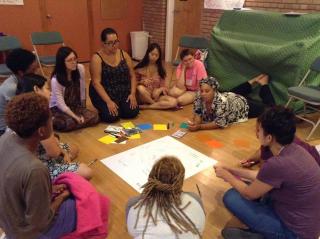
Needs and Opportunities Identified by UU Youth
Insights from conversations with UU Youth from around the Association about what they are concerned about and what they need from our congregations.
Download the 2025 Report from UUA conversations with UUA Youth (Google Slides)

Sweet Spot
Dynamic congregations rarely have a hard time dreaming new dreams, but many struggle to choose from among a parade of compelling ideas about how to use their time and energy.
Explore More

Meet the Moment
Meet the Moment is a movement-wide framework helping Unitarian Universalists analyze, discern, and take action today’s religious, cultural, generational, and political realities.