
Tapestry is Sunsetting
The UUA is no longer updating Tapestry of Faith programs.
Part of Building Bridges, Grades 8-9: A World Religions Program
-
Leader Resource 1: 600-500 BCE, Eastern Religions History GameFrom Building Bridges
A B C D E Zoroastrianism Jainism Taoism Buddhism Confucianism Founded: 600 BCE Founded: 556 BCE Founded: 550 BCE Founded: 531 BCE Founded: 500 BCE Iran India China India China Founder: Zoroaster (Zarathustra) Founder: Mahavira Founder: Lao Tzu Founder: Siddhartha Gautama Founder: K’ung-fu-tzu…
-
Leader Resource 1: Additional Judaism BackgroundFrom Building Bridges
In our previous workshop on Judaism, we learned that Judaism is monotheistic (believes there is one God), covenantal (based on a covenant of faith and practice between its believers and God), varied in its expressions, and geared to raise awareness and gratitude for every aspect of life. We also…
-
Leader Resource 1: Answers to QuizFrom Building Bridges
1. Which is the third largest religion (in number of adherents) in the world? a. Atheism/Agnosticism 2. True. Unitarian Universalism resulted from the merger of two religions—Unitarianism and Universalism—that were each more than 200 years old. 3. Abraham is considered the founder of which…
-
Leader Resource 1: Atheism-Agnosticism BackgroundFrom Building Bridges
Atheism has been granted protection as a religion under the law for purposes of freedom of religious expression and protection from religious persecution. It was established that not believing in a god or gods is a religious belief, and deserves equal protection under the law. Atheism is often…
-
Leader Resource 1: Buddhism BackgroundFrom Building Bridges
Buddhism is a religion based on rationality, objectivity, personal experience, and practice. It does not say anything about God. In fact, whether a person believes in any divine power at all is immaterial to Buddhism. What does matter? The mind. Delusions of the mind are what Buddhism seeks to…
-
 Leader Resource 1: Cave DrawingsFrom Building Bridges
The first painting is Lascaux, from France. The second painting is Altammira, from Spain. Printing This Handout Download a high-resolution copy of this Handout (PDF) for printing.
-
Leader Resource 1: Christianity 2 BackgroundFrom Building Bridges
A quick review: Christianity, born at Pentecost in approximately 30 CE, grew for a thousand years. Around 318 CE, The Holy Roman Emperor Constantine converted and the institution of the Catholic Church was founded. A huge church conflict resulted in what is called the Great Schism of 1054 CE….
-
Leader Resource 1: Evangelical Christianity BackgroundFrom Building Bridges
Evangelical Christianity is not a religion, nor an official denomination. It is a faith movement that has become especially significant in the United States over the past 50 years, in two ways: 1. Evangelical Christianity is popular, and growing. A Pew Forum survey (2007) reported that 78.4 % of…
-
Leader Resource 1: Humanism BackgroundFrom Building Bridges
Explain that the term humanist has various meanings. A person described as a humanist might have all the opinions we just discussed. But the word “humanist” is also used to describe when something is being looked at through human experience and with regard to its effect on human beings….
-
Leader Resource 1: If You BelievedFrom Building Bridges
If You Believed the Bible was the inerrant word of God and everything in it was there for a reason and that……
-
 Leader Resource 1: Image of Kuan YinFrom Building Bridges
Printing This Handout Download a high-resolution copy of this Handout (PDF) for printing.
-
Leader Resource 1: Islam BackgroundFrom Building Bridges
The Islamic faith is in the news almost every day, yet it is widely misunderstood. Approximately 1.8 billion people, nearly one in four people on Earth, are Muslim, so it is important for non-Muslims to better understand this faith and its followers. Surrender and Peace. The name of the faith,…
-
Leader Resource 1: Judaism BackgroundFrom Building Bridges
Although ancient, Judaism is not considered an indigenous religion; it is based on the revelation of religious wisdom and law to the people, not on an understanding that grows from personal experience or intuition. Revelation is believed to be a direct interaction between God and a human being.
-
Leader Resource 1: Judaism-Christianity-IslamFrom Building Bridges
Cut along the lines to create slips. Participants attach the slips to the prepared poster board with masking tape. Judaism Christianity Islam monotheism monotheism; some Trinitarian monotheism angels, demons, the Devil angels, demons, the Devil angels, demons, the Devil false prophet Son of God,…
-
Leader Resource 1: On the AltarFrom Building Bridges
Chalice Candles Altar cloth Water Cell phone Hymnbook Bowl of soil Incense Photographs of family and friends Feather Money Photographs of the sick or others in need of prayer or attention Bowl of snacks Bread for a Bread Communion Beautiful stones Writing paper and pens Mementos from deceased fam…
-
Leader Resource 1: Patron SaintsFrom Building Bridges
One unique feature of Catholicism is its saints. Thousands of people have been sainted by the Catholic Church, meaning they are officially recognized as exemplars of Christian faith, having exhibited the power of God in their lives in remarkable ways….
-
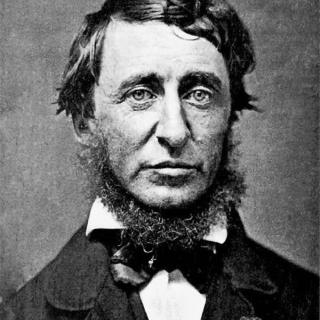 Leader Resource 1: Photographs of Thoreau, Gandhi, and KingFrom Building Bridges
Printing This Handout Download a high-resolution copy of this Handout (PDF) for printing.
-
Leader Resource 1: Taoism BackgroundFrom Building Bridges
Taoism is a faith practiced by more than 20 million people around the world. The name comes from the word “Tao,” which means “the Way.” In this case, “the Way” means a way of living in balance and at peace with all that is. Taoism is very old. We know that it existed before 550 BCE and that it…
-
 Leader Resource 1: Underground Railroad Routes MapFrom Building Bridges
Produced by the National Park Service Cartographic Staff at Harper’s Ferry Center.Reproduce the map below as large as possible or reproduce a map for each team of participants and place a dot at the beginning of a different route on each map reproduced. Printing This Handout Download a…
-
Leader Resource 1: Unitarian Universalism BackgroundFrom Building Bridges
In the three hundred or so years after Jesus lived and died, Christianity changed from a form of Judaism into a separate faith. During this time, people who lived in the lands surrounding the Mediterranean Sea held many different ideas about the nature of Jesus, God, and humanity….
-
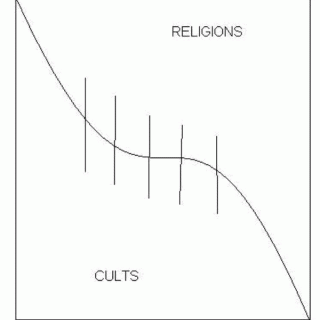 Leader Resource 1: What Do Cults and Religions DoFrom Building Bridges
Recreate the image of the poster on newsprint. Cut the phrases into slips of paper. Make everybody eat together Pressure people to give their houses, cars, money, etc. to the group Track down and/or kill people who leave the group Punish people for criticizing the group or the leadership Pressure…
-
Leader Resource 2: 1800s BackgroundFrom Building Bridges
Our exploration of religions took us back thousands of years, and we have now arrived at a point on our timeline that is relatively recent—the middle of the 19th century. The Protestant Reformation began the break from the Catholic Church in 1517, and this major religious outburst began just over…
-
Leader Resource 2: Answers to Judaism-Christianity-Islam GameFrom Building Bridges
This chart shows the beliefs held by mainstream adherents of each of the Abrahamic religions. There are many variations in beliefs, in each of these faiths….
-
Leader Resource 2: Chart of ReligionsFrom Building Bridges
Data is from a now-defunct website (adherents.com) compiled and managed by Preston Hunter; updated 2007.
-
Leader Resource 2: Christianity BackgroundFrom Building Bridges
(Label a sheet of newsprint “Christian Beliefs.”) Ask participants what Christians believe. List their responses on newsprint. Remind participants if necessary that we are not critiquing the beliefs. Make sure the following are included: One God — the God of Abraham Trinity — does not appear in…
-
Leader Resource 2: Cults BackgroundFrom Building Bridges
The first dictionary definition of “cult” is “a system of religious worship.” In other words, by the first definition, all religions everywhere are cults. This is different, however, from the way the word is most commonly used today. The number of cult members worldwide changes radically based on…
-
Leader Resource 2: Eastern Religions BackgroundFrom Building Bridges
In Iran… Beginning in 653 BCE, the Assyrian Empire to the east conquered part of the region, the Median Empire was overrun by Scythians, and a new Persian ruler took advantage of the mayhem to seize control….
-
Leader Resource 2: Hinduism BackgroundFrom Building Bridges
In this workshop, we explore a faith so ancient it is considered indigenous, yet it has grown through the millennia to attain a high level of complexity and sophistication. Furthermore, it is followed by more than 900 million people—nearly a billion human beings—around the world. This religion…
-
 Leader Resource 2: Image of ThesesFrom Building Bridges
Printing This Handout Download a high-resolution copy of this Handout (PDF) for printing.
-
 Leader Resource 2: Images of the BuddhaFrom Building Bridges
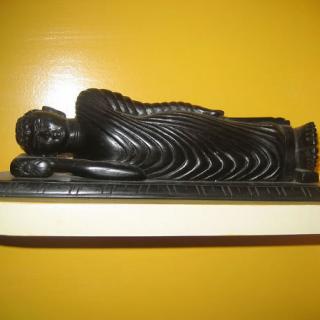
The first image is of the reclining Buddha; second image is of the Chinese Buddha; third image is of the Japanese Buddha by Jim Mills; fourth image is the Korean Buddha. Printing This Handout Download a high-resolution copy of this Handout (PDF) for printing.
-
Leader Resource 2: Indigenous Religions BackgroundFrom Building Bridges
The earliest human beings developed the four aspects of human societies: language, music, a social order, and religion. For more than three million years, human beings have practiced religion. Some of the earliest places we know human beings have lived are the southernmost tip of Africa (South…
-
Leader Resource 2: Paganism BackgroundFrom Building Bridges
“Pagan” comes from the Latin word “paganus.” Its original meaning is not clear….
-
Leader Resource 2: Quaker BackgroundFrom Building Bridges
George Fox was a young preacher in England in the mid 1600s, at the dawning of the Age of Enlightenment. Fox was disgusted by political maneuverings and coldness among church members, and by empty pleasure-seeking in the wider populace. He saw that both in and outside the church, people were not…
-
Leader Resource 2: Random Tao Te Ching ChaptersFrom Building Bridges
1 The tao that can be described is not the eternal Tao. The name that can be spoken is not the eternal Name. The nameless is the boundary of Heaven and Earth. The named is the mother of creation. Freed from desire, you can see the hidden mystery. By having desire, you can only see what is visibly…
-
Leader Resource 2: Ten Hebrew ProphetsFrom Building Bridges
Category: Daniel Was carried off to Babylon at a young age Served as a dream interpreter in the royal court of King Nebuchadnezzar; predicted Armageddon Interpreted the “handwriting on the wall” which foretold the destruction of King Belshazzar’s kingdom: “God has numbered the days of your kingdo…
-
Leader Resource 2: The Humanist Manifesto IIIFrom Building Bridges
From the American Humanist Association; used with permission.HUMANISM AND ITS ASPIRATIONS Humanist Manifesto III, a successor to the Humanist Manifesto of 1933 Humanism is a progressive philosophy of life that, without supernaturalism, affirms our ability and responsibility to lead ethical lives …
-
Leader Resource 2: The Lord's Prayer and the Pledge of AllegianceFrom Building Bridges
THE LORD’S PRAYER Our Father Who art in Heaven, Hallowed be Thy name. Thy kingdom come, Thy will be done On earth as it is in Heaven. Give us this day our daily bread And forgive us our trespasses As we forgive those who trespass against us….
-
 Leader Resource 2: UUA Chalice SymbolFrom Building Bridges
Printing This Handout Download a high-resolution copy of this Handout (PDF) for printing.
-
 Leader Resource 2: World Religions Distribution MapFrom Building Bridges
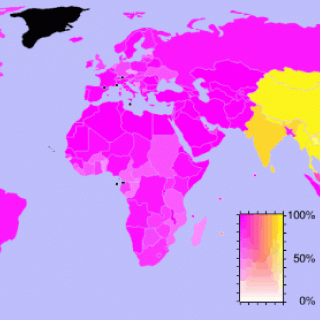
Used by permission of the author, D. Bachmann. Pink = Abrahamic faiths (Judaism, Christianity, Islam) Yellow = Dharmic faiths (Hinduism, Buddhism) Printing This Handout Download a high-resolution copy of this Handout (PDF) for printing.
-
Leader Resource 3: Chapter 10From Building Bridges
Excerpt A is a 1939 translation by Dwight Goddard. Excerpt B is a 1995 translation by Peter Merel. Excerpt C is from a translation by Charles Muller, revised in 2009. Excerpt D is a translated by James Legge, 1815–1897; used with permission. Excerpt E is from Tao Te Ching: Annotated and Explained…
-
Leader Resource 3: Dr. KelloggFrom Building Bridges
John Harvey Kellogg was born in 1852 in Michigan. He grew up in a devout Seventh-day Adventist family and believed strongly the Seventh-day Adventist teachings about healthy living. He attended medical school and returned to Michigan to begin a long and stellar surgical practice….
-
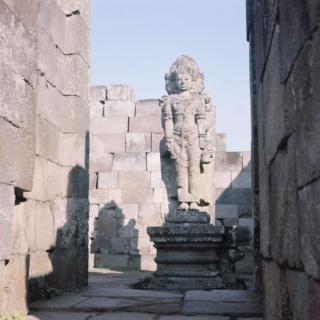 Leader Resource 3: Images of Hindu GodsFrom Building Bridges
Brahma, Shiva, Vishnu, Ganesha, Lakshmi, Kali, Durga Printing This Handout Download a high-resolution copy of this Handout (PDF) for printing.
-
Leader Resource 3: Islam 2 BackgroundFrom Building Bridges
In the previous workshop, we discussed a number of aspects of Islam. One important thing we did not look at was its two main branches. In our study of Christianity, we have learned [or, will learn] about a major split that happened about 1,500 years after Christianity began, when Martin Luther…
-
 Leader Resource 3: Jain SymbolFrom Building Bridges
Provided by Elembis. The Jain Hand symbolizes the Jain Vow of Ahimsa, or nonviolence. The Sanskrit word in the middle of the palm is “ahimsa.” The wheel represents the dharma (teachings) of Jainism, through which Jains seek to attain rational perception and ultimately freedom from the cycle of…
-
Leader Resource 3: Jewish Holy Days and HolidaysFrom Building Bridges
Holy Day/Holiday: Rosh Hashanah Celebrates: New Year (Rosh Hashanah, two days), beginning of High Holy Days period Observed by: Two-day period of worship including sounding the shofar (ram’s horn trumpet); dipping apples in honey; abstaining from work; tashlich ceremony, or symbolically casting o…
-
Leader Resource 3: Panel QuestionsFrom Building Bridges
P= Peace Advocates W= Just War Advocates Panel Questions (Both) State your position on the use of violence in human interactions. (Both) State your position on the use of violence for self-defense….
-
Leader Resource 3: ParablesFrom Building Bridges
From Christian scripture, New Revised Standard Version. 1. Mustard Seed (Matthew 13:31-32) “He put before them another parable: ‘The kingdom of heaven is like a mustard seed that someone took and sowed in his field; it is the smallest of all the seeds, but when it has grown it is the greatest of…
-
Leader Resource 3: The Eightfold PathFrom Building Bridges
Before Beginning the Eightfold Path: Right Association Since we are influenced by our companions, it is very important to have people around us who are supportive of our spiritual goals and on spiritual paths themselves. They do not need to be doing exactly what we are doing, but they have to…
-
Leader Resource 3: The Judgment of SolomonFrom Building Bridges
Adapted from Hebrew scripture, 1 Kings 3:16-28. Narrator: Now the guard brought two women to King Solomon. They stood before him. Guard: These women bring a dispute before you, my Lord. First Woman: My Lord, this woman and I live in the same house. I had a baby while she was there with me….
-
 Leader Resource 3: Wheel of the YearFrom Building Bridges
Printing This Handout Download a high-resolution copy of this Handout (PDF) for printing.
-
Leader Resource 4: BeatitudesFrom Building Bridges
From Christian scripture, New Revised Standard Version. A B Blessed are the poor in spirit: for theirs is the kingdom of heaven. Blessed are they that mourn for they shall be comforted Blessed are the meek for they shall inherit the earth Blessed are they which do hunger and thirst after…
-
 Leader Resource 4: Celtic Tree ArtFrom Building Bridges
Printing This Handout Download a high-resolution copy of this Handout (PDF) for printing.
-
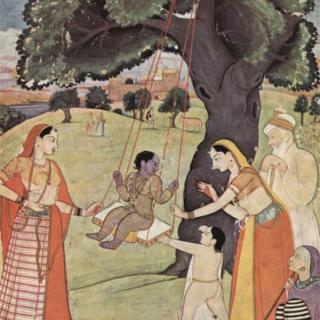 Leader Resource 4: Image of KrishnaFrom Building Bridges
Printing This Handout Download a high-resolution copy of this Handout (PDF) for printing.
-
 Leader Resource 4: Map of Middle East - Predominately Muslim Countries and IsraelFrom Building Bridges
From the website Women in Islam; fair use as permitted by website owner. Printing This Leader Resource Download a high-resolution copy (PDF) for printing.
-
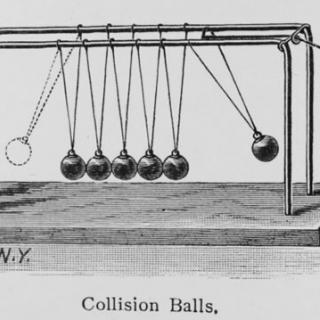 Leader Resource 4: Newton's Cradle, IllustrationFrom Building Bridges
From Scientific American. Printing This Handout Download a high-resolution copy of this Handout (PDF) for printing.
-
Leader Resource 4: OccupationsFrom Building Bridges
Lawyer, butcher, trash collector, thief, corporate executive, full-time parent, lobbyist, hair stylist or barber, grocer, graphic artist, hardware store clerk, baker or chef, computer programmer, stockbroker, animal trainer, jeweler, actor, rapper, stunt-car driver, college professor, engineer, c…
-
Leader Resource 5: Children's Chalice Lighting with GesturesFrom Building Bridges
Speak the text while performing the gestures described in italics. We light this chalice to celebrate Unitarian Universalism. When saying “Unitarian,” cup your right hand in a U shape. When saying “Universalism,” cup your left hand in a U shape. This is the church of the open mind….
-
Leader Resource 5: Pentecost and DamascusFrom Building Bridges
Part 1: Pentecost The most sacred season of the Christian liturgical year surrounds the story of the resurrection of Jesus. Holy week, the week before Easter, chronicles Jesus’ triumphant return to Jerusalem, his Last Supper with the Apostles, his betrayal by Judas, his trial and his execution on…
-
Leader Resource 6: Acts 2From Building Bridges
Acts 2: 1-24, 32-33, and 36-47, New Revised Standard Version. Here is an excerpt of the scriptural story of Pentecost: When the day of Pentecost had come, they were all together in one place….