
Tapestry is Sunsetting
The UUA is no longer updating Tapestry of Faith programs.
Part of Building Bridges, Grades 8-9: A World Religions Program
-
Handout 1: 25 Largest Christian Denominations in the United States, 2012From Building Bridges
The 2012 Yearbook of American and Canadian Churches. Used with permission.1. The Catholic Church 2. The Southern Baptist Convention 3. The United Methodist Church 4. The Church of Jesus Christ of Latter-day Saints 5. The Church of God in Christ 6. National Baptist Convention, USA, Inc. 7.
-
Handout 1: Aphorisms of ConfuciusFrom Building Bridges
Gathered from online sources including the Quotations Page and the Brainy Quote websites. 1. Those who would perfect their work must first sharpen their tools. 2. Everything has its beauty but not everyone sees it. 3. A youth is to be regarded with respect. How do you know the youth’s future will…
-
Handout 1: Buddhism Fact SheetFrom Building Bridges
Founded/Created: 531 BCE (more than 2,500 years ago). Adherents: 360 million, primarily in the East but growing worldwide. Ranking: Sixth. Prophets: Siddhartha Gautama, the Buddha (“the Awakened One”), for whom the faith is named. The Buddha, while revered, is not considered divine. Texts: The…
-
Handout 1: Declaration of SentimentsFrom Building Bridges
By Elizabeth Cady Stanton and Lucretia Mott, for the Women’s Right Convention, Seneca Falls, New York, 1848.When, in the course of human events, it becomes necessary for one portion of the family of man to assume among the people of the earth a position different from that which they have hithert…
-
Handout 1: Do You Believe...From Building Bridges
Which of the following do you believe in (or think are likely)? Circle with a red pen….
-
Handout 1: Eight Verses for Training the MindFrom Building Bridges
A highly revered text from the Mahayana Lojong (mind training) tradition, composed by the Buddhist Master Langri Tangpa (1054–1123). (1) With the determination to accomplish The highest welfare of all sentient* beings, Who excel even a wish-granting jewel, May I at all times hold them dear. (2)…
-
Handout 1: Famous Unitarians, Universalists, and Unitarian UniversalistsFrom Building Bridges
James Luther Adams, John Adams, John Quincy Adams, Margot Adler, Amos Bronson Alcott, Louisa May Alcott, Horatio Alger, Jr., Steve Allen, Susan B. Anthony, Arius (256-336 CE), Roger Nash Baldwin, Adin Ballou, Hosea Ballou, P.T….
-
Handout 1: Hinduism Fact SheetFrom Building Bridges
Emerged: Indigenous faith of India. Adherents: 900 million. Ranking: Fourth, behind Christianity, Islam, and Atheism/Agnosticism. Prophets: None, although there are numerous lineages of revered gurus and saints. Famous Hindu religious leaders include Mohandas Gandhi and Paramahansa Yogananda,…
-
Handout 1: Indigenous Religions Fact SheetFrom Building Bridges
Emerged: As early as three million years ago in China, Japan, Australia, various regions in Africa, and Southeast Asia (Hinduism is explored in Workshop 4.) Adherents: 420 million (not including Hinduism) Ranking: Fifth, behind Christianity, Islam, Atheism/Agnosticism, and Hinduism Prophets: Ther…
-
Handout 1: Judaism Fact SheetFrom Building Bridges
Birthed: Approximately 15th century BCE Adherents: 14 million, about .2-percent of the world population Ranking: Eighth, behind Christianity, Islam, Atheism/Agnosticism, Hinduism, Buddhism, Sikhism, Taoism. Nevertheless, Judaism is considered one of the “Big Five” world faiths with Christianity,…
-
Handout 1: Lord's PrayerFrom Building Bridges
Adapted from Christian scripture, various editions.Matthew 6:9-13 9 This, then, is how you should pray: “Our Father who art in heaven, hallowed be thy name. 10 Thy kingdom come; thy will be done, on earth as it is in heaven….
-
Handout 1: Pagan BeliefsFrom Building Bridges
Circle in red the beliefs that are commonly held among most Pagan sects. Circle in pencil beliefs held by some sects, though not universally. It is important to keep our lives balanced. Female qualities and male qualities should be balanced. Neither is more important than the other. They are both…
-
Handout 1: PillarsFrom Building Bridges
The Five Pillars are considered the most essential instructions from Muhammad for how to live as a Muslim. Loyal Muslims are expected to follow the Five Pillars as closely as they can. Profess Faith—Shahada Shahada—Say with conviction, “There is no God but Allah, and Muhammad is his prophet.”…
-
Handout 1: Religious Affiliation in the U.S., 2007From Building Bridges
From the Pew Forum on Religion and Public Life’s U.S. Religious Landscape Survey report. The survey included 35,556 adults; interviews were done in English and Spanish from May 8 to Aug. 13, 2007. The numbers represented are percents….
-
Handout 1: Religious Literacy QuizFrom Building Bridges
1. Which is the third largest religion (in number of adherents) in the world? a. Atheism/Agnosticism b. Judaism c. Hinduism d. Buddhism 2. True or False: Unitarian Universalism resulted from the merger of two religions—Unitarianism and Universalism—that were each more than 200 years old. 3.
-
Handout 1: Sunni and Shia - Comparison ChartFrom Building Bridges
Sunni Shia Adherents called Sunnis Shiites, Shi’i, or Shia Meaning of name “tradition” or “well-trodden path” “partisans of Ali” Current adherents 80-90% of 1.8 billion Muslims 10-20% of 1.8 billion Muslims Did Muhammad designate a successor?…
-
Handout 1: Taoism Fact SheetFrom Building Bridges
Founded/Created: It is estimated that the Tao Te Ching (DOW duh jing) was written in China in 550 BCE; however, the origins of Taoism go back hundreds of years before that. Adherents: 20 million—predominately in Asia but distributed worldwide. Ranking: Seventh in size, behind Christianity, Islam,…
-
Handout 1: Then What Would You Do or Believe?From Building Bridges
First, read Leader Resource 1, If You Believed. Circle one choice for each item….
-
Handout 1: What Makes a CultFrom Building Bridges
The information in this handout was compiled from the International Cultic Studies Association, particularly the articleRobert Jay Lifton; and “Common Characteristics of How the Cults Operate” (2009) on the Let Us Reason Ministries website. What Makes It a Cult?…
-
Handout 1: What NowFrom Building Bridges
Does your attitude about life, your base level of happiness and hope for the future, change when bad things happen to you? When bad things happen, do you tend to be: Happy and positive no matter what? Upset but generally trusting that good will come eventually? Recognizing things could be good…
-
Handout 1: Why Go to Church?From Building Bridges
TOP FIVE REASONS UNCHURCHED PEOPLE CHOOSE A CHURCH 1. Pastor/Preaching 2. Doctrines/Beliefs 3. Friendliness of members 4. Other 5. Someone witnessed/invited me TOP FIVE REASONS CHURCH ATTENDERS CHOOSE A CHURCH 1. Doctrine/Theology/Beliefs 2. People caring for each other 3. Preaching 4….
-
Handout 2: Atheism-Agnosticism Fact SheetFrom Building Bridges
Atheism/Agnosticism Existence/Reemergence: Prehistory/mid 1600s Adherents: 1.1 billion Ranking: Third—behind Christianity (2.1B) and Islam (1.5B) Influential Figures/Prophets: There are many famous people in many walks of life who identify as Atheists or Agnostics. Google “famous atheists” and…
-
Handout 2: Behavior of AbusersFrom Building Bridges
Abusers can be hard to identify because at first they can be completely charming. Skilled at gaining people’s trust, they often seem approachable, honest, generous, and kind, as they ease into people’s lives and hearts. Slowly, though, things start to go terribly wrong. The abusive behavior…
-
Handout 2: Brief Overview of the CrusadesFrom Building Bridges
The Crusades (1095-1291 CE) were a series of military campaigns by Christians primarily against the Muslims holding Jerusalem. The purpose was to regain control of Jerusalem—called the “City of God” by Christians—the city where Jesus had taught and was crucified. Muslims were equally determined…
-
Handout 2: Calvinism versus Historic UniversalismFrom Building Bridges
CALVINISM HISTORIC UNIVERSALISM Humans are inherently sinful and depraved Humans are flawed but not inherently depraved….
-
Handout 2: Comparative Chart of Eastern ReligionsFrom Building Bridges
Zoroastrianism Jainism Taoism Buddhism Confucianism Year 600 BCE 556 BCE 550 BCE 531 BCE 500 BCE Country Iran India China India China Prophet / Founder Zoroaster (Zarathustra) Mahavira, the 24th Tirthankara Lao Tzu Siddhartha Gautama K’ung-fu-tzu (Confucius) Followers 2.6 Million 4.2 M 20 M 360 M…
-
Handout 2: Excerpts from Community Cohesion: A Bahai PerspectiveFrom Building Bridges
Public response by the Baha’i Community of the United Kingdom to government studies about the race-related riots in the UK in summer, 2001….
-
Handout 2: Excerpts from The Bhagavad Gita - The Song of GodFrom Building Bridges
A sacred text of Hinduism. Introduction Circa 3000 BCE, cousins went to war over who would inherit a kingdom. Because the dispute was within a large, ancient family, the opposing armies comprised relatives, teachers, leaders, and friends. Arjuna was a master archer and renowned warrior—he was the…
-
 Handout 2: Happy HumanFrom Building Bridges
From the British Humanist Association.Printing This Handout Download a high-resolution copy of this Handout (PDF) for printing.
-
Handout 2: Islam Fact SheetFrom Building Bridges
Dates from: 622 CE in Mekka (in Saudi Arabia) Note: Muslims believe Islam is the only true religion and has no beginning; 622 CE is the date the Islamic calendar began, keyed to an important event in Muhammad’s life Adherents: 1.8 billion (80-90% Sunni; 10-20% Shiite) Ranking: Second, behind…
-
Handout 2: Lyrics - Chant for the SeasonsFrom Building Bridges
Hymn 78 in Singing the Living Tradition; words by Mark Belletini; musical arrangement by Grace Lewis McLauren.Summertime has turned the starwheel, autumn is upon us. Sweet the angling sun, sweet upon the air the smell of blue mist rising. Summertime has turned the starwheel, autumn is upon us.
-
Handout 2: Position - Muslim Women Are EqualFrom Building Bridges
Muslim women are equal to men and equally valued. The Holy Qur’an states that women and men were created from a single soul and are moral equals in the eyes of God. Qur’an 4:1: “O mankind!…
-
Handout 2: Quaker Peace TestimoniesFrom Building Bridges
I. George Fox, in Declaration to King Charles II, 1660 All bloody principles and practices we utterly deny, all outward wars, and strife, and fightings with outward weapons, for any end or under any pretence whatsoever, and this is our testimony to the whole world….
-
Handout 2: RiverTree Christian Church - What We BelieveFrom Building Bridges
From the website of the RiverTree Christian Church of Massillon, Ohio. Used with permission.There is ONE GOD who is the source of everything God is one and He exists as three equal persons, Father, Son, and Holy Spirit. God has existed eternally and is the creator of everything that exists in the…
-
Handout 2: Scenes of Prospective ConflictFrom Building Bridges
Here are some situations where you might have trouble keeping your cool. You drop your cell phone and somebody steps on it, destroying it. Someone hits your compact car with their SUV. You are a clerk in a store and a furious customer brings back a defective product. Two of your friends have a…
-
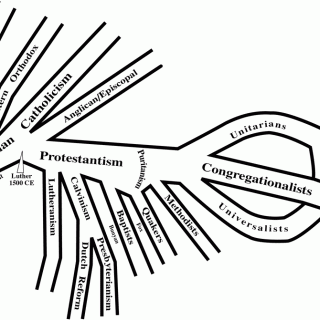 Handout 2: Source Religions of Unitarian UniversalismFrom Building Bridges
Printing This Handout Download a high-resolution copy of this Handout (PDF) for printing.
-
Handout 2: The Ten CommandmentsFrom Building Bridges
Traditional adaptations from Hebrew scripture, Exodus 20:2-14. Jewish Ten Commandments 1. I am the Lord your G-d. 2. You shall have no other gods before me; You shall not make for yourself an idol. 3. You shall not make wrongful use of the name of the Lord your G-d. 4….
-
Handout 2: Traditional Jewish NamesFrom Building Bridges
Abram — Exalted Father Abraham — Father of Many / Father of Nations Amos — To Carry Baruch — Blessed Benjamin — Son of the South Chaya — Life Esther — Star Ethan — Solid, Enduring Ezra — Help David — Beloved Deborah — Bee Ephraim — Fruitful Eli — Height, Ascension Hannah…
-
 Handout 2: Yin-Yang SymbolFrom Building Bridges
Printing This Handout Download a high-resolution copy of this Handout (PDF) for printing.
-
Handout 3: 1800s Religions - Five Faiths GridFrom Building Bridges
Church of Jesus Christ of Latter-day Saints Baha’i Faith Seventh-day Adventists Church of Christ, Scientist Jehovah’s Witnesses Known as… Mormons Baha’is Adventists Christian Scientists Witnesses Year 1830 1863 1863 1879 1879 Founder/ Prophet P/F-Joseph Smith P/F-Baha’u’llah F-Ellen G. White,…
-
Handout 3: Child StarvationFrom Building Bridges
Statistics from: Reference.com, UNICEF, Bread For the World, Child Trends Data Bank, Online Encyclopedia, Hunger Notes, and We Are Austin.Child Starvation Every 3.6 seconds a person dies of starvation Conservative figures show that five million children under age five die from hunger-related caus…
-
Handout 3: Christianity Fact SheetFrom Building Bridges
Founded/Created: 30 CE (crucifixion of Jesus) Adherents: 2.1 billion — 1.13 billion Catholics; 225 million Orthodox; 970 million Protestants Ranking: First; the most populous religion on earth. Catholicism alone would be second, behind Islam Prophets: Jesus of Nazareth, called Jesus Christ Texts:…
-
Handout 3: Humanism Fact SheetFrom Building Bridges
Origin: Dates from Greek and Roman antiquity; then, the European Renaissance; then as a philosophic and theological movement in the U.S. and Europe, mid-1800s and again in 1920s and 1930s, through today. Adherents: Number unknown….
-
Handout 3: Laws of KashrutFrom Building Bridges
“Kashrut” means “fitness.” Food that has been prepared according to the laws of kashrut is kosher—”fit”—for consumption by an observant Jew. Many Reform Jews do not keep kosher; Orthodox Jews eat only kosher food; Conservative Jews usually follow the laws of kashrut but less strictly than their…
-
Handout 3: Neo-Paganism and Wicca Fact SheetFrom Building Bridges
Emerged: Neo Paganism is based on what is assumed to be ancient, indigenous religions, but modern day Wicca is dated as beginning in 1959 and the current Neo-Paganism movement can be dated to the founding of the Church of All Worlds and Feraferia in 1967….
-
Handout 3: Nicene CreedFrom Building Bridges
1975 Ecumenical Version, published by Prayers We Have in Common and adopted by the Roman Catholic Church and many mainstream Protestant denominations. NOTE: “Ecumenical” means pertaining to the whole Christian Church; promoting or fostering Christian unity throughout the world….
-
Handout 3: Position - Muslim Women Are Not EqualFrom Building Bridges
Muslim women are not considered equal to men or valued equally with men in Islamic society. The Holy Qur’an states clearly that women are to be subordinate to men. Qur’an 4.34: “Men stand superior to women in that God hath preferred some of them over others, and in that they expend of their…
-
Handout 3: The ATF Creed - Acquire the FireFrom Building Bridges
From the no-longer-active website of Acquire the Fire, a touring event sponsored for 30 years by Teen Mania Ministries, a Christian youth organization that staged events with speakers and live music. Read in Christianity Today about the decision in 2015 to end the Acquire the Fire events.
-
Handout 3: The Principles of the Unitarian Universalist AssociationFrom Building Bridges
There are seven Principles which Unitarian Universalist congregations affirm and promote: The inherent worth and dignity of every person; Justice, equity and compassion in human relations; Acceptance of one another and encouragement to spiritual growth in our congregations; A free and responsible…
-
Handout 3: The Seven UU PrinciplesFrom Building Bridges
The inherent worth and dignity of every person Justice, equity, and compassion in human relations Acceptance of one another and encouragement to spiritual growth in our congregations A free and responsible search for truth and meaning The right of conscience and the use of the democratic process…
-
Handout 4: Core ValuesFrom Building Bridges
Unitarian Universalist Principles in Children’s Language 1. We believe that each and every person is important. 2. We believe that all people should be treated fairly and kindly. 3. We believe that we should accept one another and keep on learning together. 4. We believe that each person must be…
-
Handout 4: Excerpts from the Holy QuranFrom Building Bridges
From the Qur’an, Rodwell edition (1876) and Palmer edition (1880).Excerpt from Sura II, The Cow He said, “O Adam, inform them (the angels) of their names.” And when he had informed them of their names, He said, “Did I not say to you that I know the hidden things of the Heavens and of the Earth, a…
-
Handout 4: Unitarian Universalism Fact SheetFrom Building Bridges
Founded/Created: Two Christian denominations with religious traditions dating back 2,000 years to early Christianity consolidated in 1961 to form the Unitarian Universalist Association. In the United States, Unitarian thought arose within established churches in the late 1700s; the American…
-
Handout 4: UU Response to Westboro Baptist ChurchFrom Building Bridges
Excerpted from the website of the UUA’s Side with Love campaign; used with permission.Nov 16, 2010—UUs from Virginia didn’t allow the Westboro Baptist Church’s hate messages to go unchecked when the anti-gay group announced they were coming to town. By Melodie Feather On Wednesday morning…
-
Handout 4: What to Expect in Quaker MeetingFrom Building Bridges
From the Friends General Conference website. Accessed July 18, 2011. Used by permission.WELCOME Everyone is always welcome at a Quaker meeting for worship. In worship Friends gather into silent, expectant waiting. We hold ourselves open to the Light and reach for the divine center of our being….
-
Handout 5: Names of SatanFrom Building Bridges
These are names by which Satan is called in the Bible: Abaddon — Hebrew for “destruction” King of the Bottomless Pit Accuser Lawless One Adversary Leviathan Angel of Light (a being Satan can transform into) Liar Angel of the bottomless pit Lucifer Antichrist Murderer Apollyon — Greek for…
-
Handout 5: Quaker Fact SheetFrom Building Bridges
Full Name: Religious Society of Friends Founded: Great Britain, 1647 Founder: George Fox Derivation of Full Name: Jesus said, “You are my friends if you do what I command you” (Christian scripture, John 15:14). Derivation of Common Name (Quakers): Intended as an insult to George Fox by a judge…
-
Handout 5: Sikh Pop QuizFrom Building Bridges
From the Sikh Coalition, 40 Exchange Place, Suite 728, NY, NY 10004, 1-212-655-3095 and the website Khalsa Kids.1. If you meet a Sikh, an appropriate way to greet them is: a. “Salaam Alaikum” b. “Namaste” c. “Sat Sri Akal” d. “Bonjour” 2. Ninety-nine percent of the persons who wear turbans in the…
-
Handout 5: Unitarians Worked to Save Ute IndiansFrom Building Bridges
Originally published in UU World magazine, Winter, 2009 and available online. In 1870, President Ulysses S. Grant invited Protestant denominations to take over the management of American Indian reservations and agencies. His hope was that this move would cut down on reported government corruption…
-
Handout 6: The Turban and Five Ks of SikhismFrom Building Bridges
The Five Ks (in Punjabi “Panj Kakkar”) are symbols of faith worn by baptized Sikh men and women. The name, Panj Kakkar or Five Ks, comes from all five items beginning with the letter “K.” It is considered an honor to wear the Five Ks and (for men) turban which publicly identify the wearer as Sikh.