
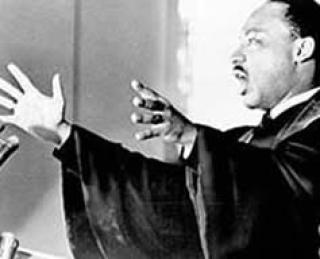
This week in 1966, Rev. Dr. Martin Luther King, Jr. delivered one of the most powerful and significant Ware Lectures in the more than a hundred year history of the lecture. The UUA’s General Assembly was in Hollywood, Florida that year – King was invited to speak to Unitarian Universalists (UU) only a year after two UUs, Rev. James Reeb and Viola Liuzzo, were murdered by white supremacists in Alabama because of their actions in support of the Civil Rights Movement.
King’s lecture was entitled, “Don’t Sleep Through the Revolution”. Six decades later, it’s remarkable how similar to our present situation his words read – and how vital his call to prophetic witness remains. He starts the lecture by recounting Washington Irving’s classic early American story, “Rip Van Winkle,” and reminding us that when Van Winkle fell asleep, King George III ruled the American colonies. When he woke up 20 years later, the first President of the United States, George Washington, was now leading a newly-formed country. “One of the great misfortunes of history is that all too many individuals and institutions find themselves in a great period of change and yet fail to achieve the new attitudes and outlooks that the new situation demands. There is nothing more tragic than to sleep through a revolution,” said King.
The lecture is a rich text that remains extremely relevant, so we recommend you take a few minutes to read it in its entirety. But we want to focus on three points Dr. King made that we think will resonate with UUs and non-UUs alike.
“All life is inter-related, and somehow we are all tied together.”
Though Dr. King didn’t use the word, he expressed why interdependence has become a shared value of Unitarian Universalists as well as a belief that other people of faith and good will hold. He described a realization he had after visiting India with his wife, Coretta Scott King, that this nation’s destiny is tied with the destiny of that country and its people, and as such, we had a responsibility to address poverty, hungry, and housing conditions there just as we do here. “We must live together as brothers or we will all perish together as fools. This is a fact of life. No individual can live alone, no nation can live alone,” King said.
“[Racial segregation] is not only sociologically untenable, or politically unsound, or merely economically unwise, it is morally wrong and sinful.”
Dr. King details the immorality of racism, both in belief and actions, at great length in the lecture. Throughout the denomination’s history, and certainly since the merger between Unitarians and Universalists in 1961, UUs have followed the call to action King laid out to end not only racial segregation but also to push back against racism and white supremacy. In 2021, the UUA issued a Statement of Conscience, “Undoing Systemic White Supremacy: A Call to Prophetic Action,” that called on the UUA and Unitarian Universalists “to actively engage in undoing systemic white supremacy in all of its manifestations.” That anti-racism work remains an important part of what we do today.
“It may be true that the law cannot change the heart, but it can restrain the heartless.”
In an era where so many people feel despair and wonder if the work they are doing will result in change, Dr. King’s words on the importance of both action and legislation seem particularly timely. As a condition of being awake to the revolution, King said, “it is not enough for the church to work in the ideological realm, and to clear up misguided ideas. To remain awake through this social revolution, the church must engage in strong action programs to get rid of the last vestiges of segregation and discrimination.” In particular, he focused on the importance of legislation to bring change, and specifically highlighted the interfaith work that led to landmark civil rights laws. In speaking of the Voting Rights Act, recently gutted by the U.S. Supreme Court, he said, “That bill is a tribute to persons like James Reeb, Mrs. Viola Liuzzo and Jimmy Lee Jackson, those who died and suffered to make it possible.”
King ended his Ware Lecture with a meditation on the importance of hope in times of difficulty or despair. He highlights the long and deep history of Black Americans in this country, and how consistently Black people have overcome efforts to oppress and humiliate them. Reiterating his famous paraphrase of the 19th century Unitarian minister Rev. Theodore Parker, King said, “If the inexpressible cruelties of slavery couldn’t stop us, the opposition that we now face will surely fail. We’re going to win our freedom because both the sacred heritage of our nation and the eternal will of the almighty God are embodied in our echoing demands. And we can sing We Shall Overcome, because somehow we know the arc of the moral universe is long but it bends toward justice.”
2026 Ware Lecture – Bishop Mariann Edgar Budde

This year’s Ware Lecture will be delivered by Bishop Mariann Edgar Budde, the spiritual leader for the congregations and Episcopal schools in the District of Columbia and the four Maryland counties that comprise the Episcopal Diocese of Washington. She is the first woman to have been elected to this position. You can read more about Bishop Budde at the Ware Lecture section of the UUA’s website.